
🌀The Universe Is Free
Alan Guth, MIT, 1980.
In 1980, physicist Alan Guth launched an idea that shook cosmology: the universe, just 10⁻³⁶ seconds after the Big Bang, expanded brutally, in a burst of cosmic inflation. This lightning expansion solved enigmas that until then seemed insoluble:
Why does the universe look so flat?
Why do such distant regions share the same temperature?
Where did the exotic particles that theories predicted go?
📡 The Imprint of Galaxies
Inflation not only answered these questions; it also sowed the fertile chaos of quantum fluctuations that, over time, became galaxies.
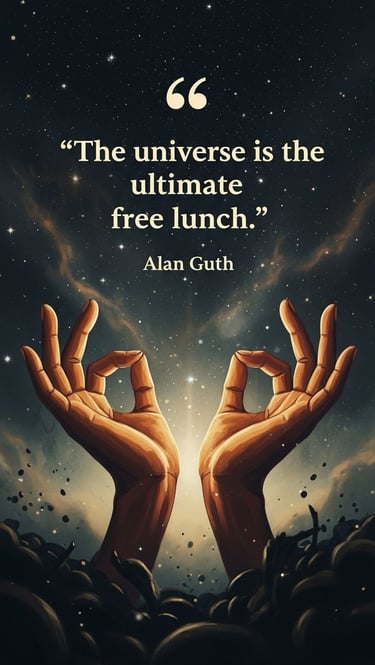
But Guth left behind more than just a theory. He left a phrase that is almost a cosmic magician's trick:
“The universe is the ultimate free lunch.” — Alan Guth
🥂 The Biggest Free Lunch in History
The joke is serious. Matter has positive energy, gravity has negative energy, and in the sum total they could cancel each other out. Zero balance. The entire universe could have sprung up from nothing, at no net cost. Free.
Here rigor becomes poetry: the greatest spectacle of all time perhaps cost nothing. A balanced equation disguised as a miracle.
✨ Science Becomes Poetry
The Rabbit Hole begins with this paradox. Because it's not just about understanding how the cosmos began, but about letting ourselves be swept away by the uncomfortable and fascinating idea that everything—space, time, consciousness—may be the cheapest cosmic lunch in history.